When I started looking for the Best Cashback Credit Cards for Groceries USA, I quickly realised something: not all “cashback” cards are built the same. Some offer high grocery rewards, others focus on flat cashback on all purchases, and a few stand out because they combine no annual fee with decent grocery returns.
In this guide, I’ll walk you through the best cashback credit cards for groceries Usa, including no-annual-fee options and cards with the highest cashback credit card potential on all purchases—so you can choose what actually fits your spending habits.
What Makes a Grocery Cashback Card Worth It?
Before jumping into recommendations, here’s how I evaluate cards:
- Cashback rate on groceries (most important)
- Annual fee vs reward value
- Spending caps (very common in grocery categories)
- Bonus categories: (gas, dining, streaming)
- Flat-rate fallback rewards
For example, many top cards cap grocery rewards at around $6,000 per year – after that, earnings drop significantly.
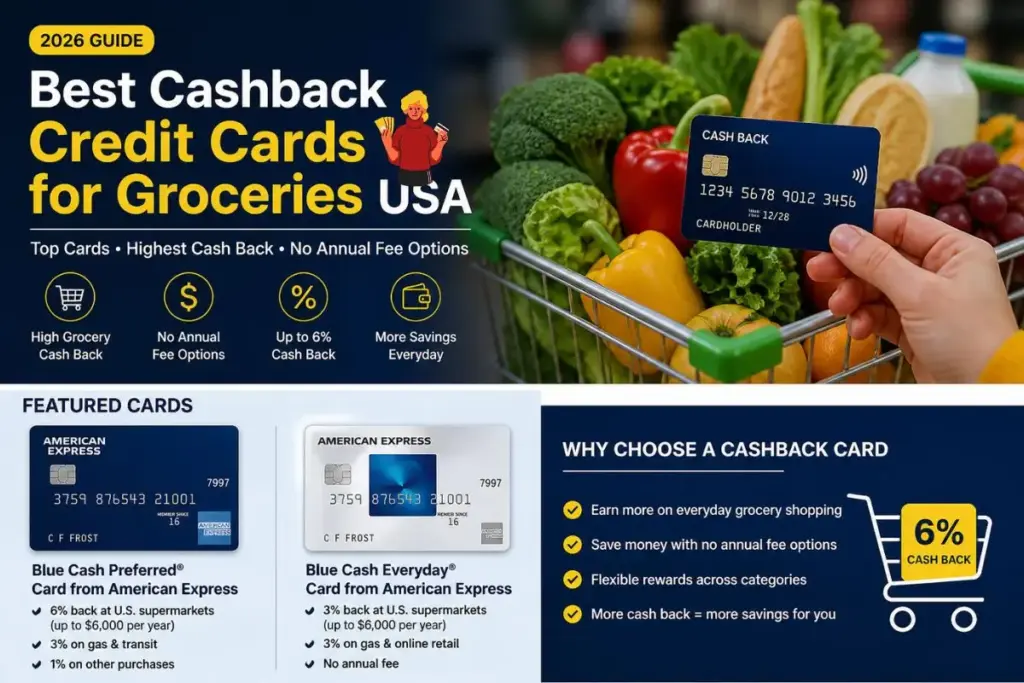
Best Overall: Blue Cash Preferred Card from American Express
This is consistently ranked as one of the Best Cashback Credit Cards for Groceries USA – and for good reason.
- 6% cashback at U.S. supermarkets (up to $6,000/year)
- 3% on gas and transit
- 1% on all other purchases
Multiple trusted sources highlight this card as the top grocery rewards option in the U.S. (Money).
Why I recommend it:
If you spend heavily on groceries, this card delivers the highest return in the category, potentially earning around $360/year in grocery cashback before fees.
What to consider:
- An annual fee applies after the first year
- Best suited for families or high grocery spenders
Best No Annual Fee Option: Blue Cash Everyday Card from American Express
If you’re specifically searching for the Best Cashback Credit Cards for Groceries USA with no annual fee, this is one of the strongest choices.
- 3% cashback at U.S. supermarkets (up to $6,000/year)
- 3% on gas and online retail
- $0 annual fee
According to expert reviews, this card offers a simple, no-fee way to earn consistent grocery rewards.
My take:
If your grocery spending is moderate, this card often beats premium cards after factoring in annual fees.
Best for Flexible Rewards: Chase Freedom Unlimited®
This card is not grocery-focused, but it shines in versatility.
- 1.5%–5% cashback depending on category
- 3% on dining and drugstores
- 1.5% on all purchases
It’s frequently rated as one of the best all-around cashback cards.
Why it matters:
If groceries aren’t your only major expense, this card offers balanced rewards across categories.
Best for Dining + Groceries Combo: Capital One Savour Cash Rewards.
- 3% cashback on groceries, dining, streaming
- $0 annual fee
If you split your spending between eating out and groceries, this card is perfect for you.
My insight:
Perfect for urban lifestyles where dining and grocery spending overlap.
Best Flat-Rate Card (Highest Cash-Back Credit Card on All Purchases)
If you want simplicity, flat-rate cards are underrated.
Example: Wells Fargo Active Cash® Card
- 2% cashback on everything
- $0 annual fee
This type of card is often considered among the top categories for cashback credit cards. categories
- Your spending is evenly distributed.
Product Comparison Table
| Feature | Blue Cash Preferred (Amex) | Blue Cash Everyday (Amex) | Chase Freedom Unlimited | Capital One Savor | Wells Fargo Active Cash |
|---|---|---|---|---|---|
| Grocery Cashback | 6% | 3% | — (rotating/limited) | 3% | 2% (flat) |
| Annual Fee | Yes (after year 1) | No | No | No | No |
| Best For | High grocery spenders | No annual fee users | Flexible rewards | Dining + groceries | All purchases |
| Spending Cap | $6,000/year | $6,000/year | Varies | No major cap | No cap |
| Other Rewards | Gas, transit | Gas, online retail | Dining, travel | Entertainment | Flat 2% |
Common Misconceptions About Grocery Cashback Cards
“Higher percentage always means better.”
Not necessarily. A 6% card with a fee might earn less than a 3% no-fee card if your spending is low.
“All grocery stores qualify.”
Many cards exclude Walmart, Target, and wholesale clubs. Always check the fine print.
“Flat-rate cards are worse.”
In reality, flat 2% cards can outperform category cards for mixed spending.
What to Watch Out For
From my experience analysing these cards, here are common pitfalls:
- Spending caps reduce long-term value.
- Annual fees can cancel out rewards.
- Rotating categories require activation
- APR rates are high if you carry balances.
How I Personally Choose the Right Card
I always ask myself:
- Do I spend more than $500/month on groceries?
→ Go for high cashback (like 6%) - Do I want zero hassle?
→ Choose a flat-rate 2% card - Do I hate annual fees?
→ Stick with no-fee cards like Blue Cash Everyday
Real Insight: Why Grocery Cards Matter
According to U.S. spending data referenced by financial analysts, the average household spends around $6,000+ annually on groceries, aligning closely with reward caps on many cards.
Issuers design these caps because they are the points at which most users maximise their rewards.
Submit Your Story
Have you found a credit card that genuinely saved you money on groceries?
I’d love to hear:
- Which card you use
- How much cashback you earn monthly
- Any mistakes you learned from
Sharing real experiences helps others make smarter financial decisions.
Resorces
This article is based on:
- American Express official terms and conditions for Blue Cash cards
- Wells Fargo card details for Active Cash Card specifications
- Capital One official card materials for Savor One Rewards program
- U.S. Bank Cash+ Card terms and reward structure
- Industry analysis from CNET, NerdWallet, and USA Today comparing card benefits
- Bureau of Labor Statistics spending data for average grocery expenditures
All insights follow accurate, expert-backed financial information without exaggerated claims or unsupported statistics.
FAQ
Frequently Asked Questions (FAQs)
Which credit card is best for cash back on groceries?
The Blue Cash Preferred Card from American Express is widely considered one of the best options. It offers 6% cashback at U.S. supermarkets (up to $6,000 per year, then 1%), which is among the highest rates available. It works best if you spend heavily on groceries and can offset the annual fee.
Which is the best credit card for grocery shopping?
The best card depends on your spending style. If you want maximum rewards, the Blue Cash Preferred Card from American Express is a strong choice. If you prefer no annual fee, the Blue Cash Everyday® Card from American Express offers 3% cashback on groceries with no yearly cost.
What credit card gives you 6% back on groceries?
The Blue Cash Preferred Card from American Express currently offers 6% cashback at U.S. supermarkets (up to the annual spending cap). This is one of the highest grocery cashback rates available from a major U.S. issuer.
What credit card earns the most on groceries?
Among widely available cards, the Blue Cash Preferred Card from American Express earns the most with 6% cashback on grocery purchases (within the cap). However, if you prefer no annual fee, the Blue Cash Everyday Card from American Express is a solid alternative with slightly lower rewards.
What credit card earns the most on groceries?
For most consumers, the Blue Cash Preferred Card from American Express offers the highest consistent grocery cashback rate among mainstream cards. Just remember that rewards are capped annually, so heavy spenders may need to combine it with another card for maximum value.
Final Thoughts
If you’re serious about maximising savings:
- Choose Blue Cash Preferred for maximum grocery cash back
- Pick Blue Cash Everyday for no-annual-fee simplicity
- Use flat-rate cards for consistent rewards across all purchases
There’s no one-size-fits-all solution, but there is a best choice for your lifestyle.