I still remember when I got my first credit card—it felt like a big step toward financial independence. At the same time, I had questions: Is this really helpful? What are the risks? If you’re asking similar questions, you’re not alone.
Benefits of a Credit Card Usa In this guide, I’ll walk you through the main 10 benefits of Credit Card, explain Credit Card benefits and loss, and break things down in a way that actually makes sense—especially for readers in the United States. I’ll also include sections on Key Features and Rewards, Perks and Benefits, and Key Considerations, so you get a complete picture before making any decision.
Why Credit Cards Are Important in the USA
In the U.S., credit cards are deeply tied to your financial life. Your credit history influences everything—from renting an apartment to getting a loan. Organizations like the Consumer Financial Protection Bureau and major credit bureaus such as Experian emphasize responsible usage as a key part of financial health.
Main 10 Benefits of a Credit Card Usa
Here are the main 10 Benefits of a Credit Card Usa that I’ve personally found most useful—and that align with standard financial guidance in the U.S.:
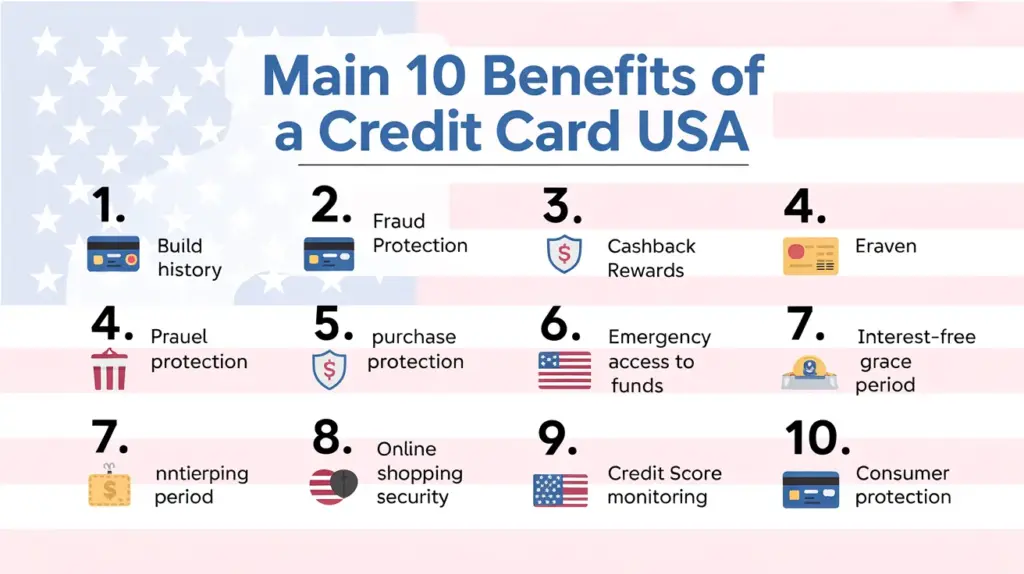
1. Builds Your Credit Score
Using a credit card responsibly (paying on time, low utilization) helps build your credit score, which is essential in the U.S. financial system.
2. Interest-Free Grace Period
Most cards offer a grace period. If I pay the full balance by the due date, I avoid interest completely.
3. Rewards and Cashback
Many U.S. cards offer cashback (1%–5%) or travel points, making everyday spending more rewarding.
4. Fraud Protection
Credit cards often provide zero-liability protection against unauthorized transactions, which is safer than using debit cards.
5. Purchase Protection
Some cards cover damaged or stolen purchases for a limited time after buying.
6. Travel Benefits
Premium cards often include travel insurance, rental car coverage, and airport lounge access.
7. Emergency Financial Backup
In urgent situations, a credit card can provide immediate access to funds.
8. EMI / Installment Options
In the U.S., this may appear as “Buy Now, Pay Later” or fixed payment plans.
9. Global Acceptance
Credit cards are widely accepted worldwide, making travel easier.
10. Exclusive Offers
You often get discounts on dining, shopping, and subscriptions.
Benefits of a Credit Card Usa Overview (Quick Comparison)
| Feature | Benefit | What to Keep in Mind |
|---|---|---|
| Interest-Free Period | No interest if paid on time | Missing due date leads to high interest |
| Rewards & Cashback | Earn money or points on spending | Categories may vary |
| Credit Score Building | Helps future loans and approvals | Requires disciplined usage |
| Fraud Protection | Strong security features | Monitor transactions regularly |
| Travel Perks | Insurance, lounge access | Often tied to premium cards |
| Global Usage | Accepted worldwide | Foreign transaction fees |
Key Features and Rewards
When I evaluate any credit card, I focus first on Key Features and Rewards because they directly impact daily usage.
Cashback Programs
Many U.S. credit cards offer tiered cashback:
- 1% on general purchases
- 2–5% on categories like groceries, gas, or dining
Rewards Points
Some cards provide points that can be redeemed for:
- Travel bookings
- Gift cards
- Statement credits
Sign-Up Bonuses
A major highlight in the U.S. market is the welcome bonus. Some cards offer significant rewards if you meet a spending requirement within the first few months.
Introductory APR Offers
Certain cards offer 0% APR for a limited time, which can help manage large expenses.
Perks and Benefits
Beyond basic rewards, Perks and Benefits can make a big difference in real-life usage.
Travel Perks
- Airport lounge access
- Travel insurance
- No foreign transaction fees (on select cards)
Lifestyle Benefits
- Dining discounts
- Entertainment offers
- Subscription deals
Purchase Protection
Many cards offer:
- Extended warranty
- Price protection
- Return protection
Security Features
Credit cards in the U.S. come with:
- Fraud alerts
- Transaction monitoring
- Easy dispute resolution
From my experience, these perks often provide more value than the basic rewards.
Credit Card Benefits and Loss (Balanced View)
It’s important to look at both sides honestly.
Benefits
- Financial flexibility
- Rewards and cashback
- Strong fraud protection
- Credit building
Loss / Risks
- High interest rates (often 15%–25% APR in the U.S.)
- Late fees and penalties
- Risk of debt if mismanaged
- Impact on credit score if payments are missed
I always remind myself: the benefits only work if I stay disciplined.
Key Categories for Comparison
- No Annual Fee / Cash Back Cards — Great for beginners or simple rewards.
- Mid-Tier Travel Rewards Cards ($95 fee) — Good balance of value for occasional travelers.
- Premium Travel/Lifestyle Cards — Higher fees but strong perks for frequent travelers.
Top Credit Cards Comparison (March/April 2026 Data)
| Card Name | Annual Fee | Welcome Bonus (approx.) | Rewards Rates (key categories) | Best For | Drawbacks |
|---|---|---|---|---|---|
| Chase Freedom Unlimited® | $0 | $250 cash back (after $500 spend) | 5% on travel via Chase, 3% dining/drugstores, 1.5% everything else | Everyday cash back, beginners | Lower base rate on non-bonus spend |
| Wells Fargo Active Cash® | $0 | $200 cash back | Flat 2% cash back on all purchases | Simple, no-category cash back | No bonus categories or travel perks |
| Citi Double Cash® | $0 | $200 cash back | 2% total (1% when you buy + 1% when you pay) | Flat-rate cash back | Rewards as cash only (no transfer partners) |
| Capital One Venture Rewards | $95 | 75,000 miles + $250 travel credit | 2x–5x miles (5x on hotels/cars via Capital One Travel) | Simple travel rewards | Miles redemption can be less flexible than Chase |
| Chase Sapphire Preferred® | $95 | 75,000 points (after $5,000 spend) | 5x travel via Chase, 3x dining/online groceries/streaming, 2x other travel | Flexible travel (points transfer well) | $95 fee; best value if you travel |
| Capital One VentureOne | $0 | 20,000–40,000 miles | 1.25x–5x miles | No-fee entry to travel miles | Lower earning rate than paid versions |
| American Express® Gold Card | $325 | Up to 100,000 points (targeted) | 4x dining (up to $50k/year), 3x flights | Dining & grocery lovers | High fee; grocery/dining heavy focus |
| Capital One Venture X | $395 | High bonus (varies) | 10x hotels/cars via portal, 5x flights, 2x everything | Premium flat-rate travel | Higher fee, but strong credits offset it |
Notes on the table:
- Bonuses and rates can change; always check the issuer’s site for current offers.
- Many cards offer 0% intro APR on purchases/balance transfers (e.g., Wells Fargo Reflect® for long intro periods).
- Rewards value: Chase and Amex points often worth more (1.5–2+ cents each) when transferred to airlines/hotels. Capital One miles and cash back are usually ~1 cent each.
Quick Recommendations by Need
- Best for Beginners or Simple Cash Back — Start with Chase Freedom Unlimited® or Wells Fargo Active Cash®. No fee, easy to use, solid welcome bonus.
- Best Everyday / No-Fuss Rewards — Citi Double Cash® or Wells Fargo Active Cash® for true flat-rate earning without tracking categories.
- Best for Travel (Balanced) — Chase Sapphire Preferred® — excellent transfer partners (airlines/hotels) and strong everyday categories. Great “first premium” card.
- Best Simple Travel Miles — Capital One Venture Rewards — easy 2x everywhere, erase travel purchases with miles.
- Best for Dining/Groceries — American Express® Gold Card — high multipliers on food spending, but the fee requires heavy use to offset.
- Premium Travelers — Consider Chase Sapphire Reserve® or Capital One Venture X for lounge access, credits, and higher multipliers (higher fees apply).
Other Factors to Consider When Comparing
- Welcome Bonuses — Most require minimum spend in 3 months. Aim for cards where you can naturally hit the spend.
- Redemption Flexibility — Chase Ultimate Rewards and Amex Membership Rewards shine here due to transfer partners.
- Foreign Transaction Fees — Most travel cards waive them; cash-back cards sometimes do not.
- Credit Score Needed — No-fee cards like Freedom Unlimited often approve good/fair credit. Premium cards usually want excellent credit (700+ FICO).
- Perks & Protections — Look for purchase protection, extended warranty, travel insurance, and statement credits (e.g., $250 travel credit on some Venture cards).
- 0% Intro APR — Useful if carrying a balance or doing big purchases (e.g., Wells Fargo Reflect® offers long periods).
Tips from Experience (Practical Guide Style)
Check Pre-Approval — Use issuer tools (Chase, Capital One, Amex) to see offers without a hard inquiry.
Match to Your Spending — Track 1–2 months of expenses. If you spend heavily on dining/travel → go premium. If mostly gas/groceries → rotating category or flat-rate cards.
Stack Cards — Many people pair a no-fee cash-back card (e.g., Freedom Unlimited) with a travel card (Sapphire Preferred) for maximum value via point transfers.
Annual Fee Math — A $95 fee is easy to offset with one good trip or credits. A $325+ fee needs $500+ in annual value from perks.
Build Credit Safely — Pay on time, keep utilization under 30%. Beginners may start with secured or student versions.
Key Considerations Before Getting a Credit Card
This is where many people make mistakes. Here are the key considerations I personally follow:
1. Understand Interest Rates (APR)
If you carry a balance, interest can add up quickly.
2. Annual Fees
Some cards charge yearly fees. Make sure the benefits justify the cost.
3. Your Spending Habits
Choose a card that matches your lifestyle (travel, groceries, etc.).
4. Credit Score Requirement
Some premium cards require excellent credit.
5. Fees and Charges
Watch for:
- Late payment fees
- Foreign transaction fees
- Cash advance fees
What to Do and What NOT to Do
What I Recommend
- Always pay the full balance on time
- Keep credit utilization below 30%
- Track your spending
What to Avoid
- Paying only the minimum amount
- Ignoring statements
- Using credit for unnecessary purchases
Common Misconceptions About Credit Cards
“Credit cards are dangerous”
They are only risky if misused.
“You must carry a balance to build credit”
Not true. Paying in full is actually better.
“All credit cards are the same”
Different cards offer very different benefits.
Emotional Reality: You’re Not Alone
If managing a credit card feels confusing, I understand. I’ve made mistakes too. The key is learning, adjusting, and improving over time.
Financial confidence doesn’t happen overnight—it builds step by step.
Future Outlook: What Happens If You Use It Right
When used responsibly, a credit card can help you:
- Build a strong credit profile
- Qualify for better loans
- Access premium financial products
- Enjoy financial flexibility
But if ignored, it can lead to long-term debt and stress.
FAQs
What are the major Benefits of a Credit Card Usa?
Credit cards provide convenience, rewards, fraud protection, and help build your credit score when used responsibly.
What are 5 disadvantages of a credit card?
High interest rates, overspending risk, late fees, credit score damage, and additional charges.
What happens after 7 years of not paying credit cards?
The debt may stay on your credit report for up to 7 years, significantly affecting your credit score and financial opportunities.
What are the benefits of having credit cards?
They help build credit history, offer rewards, provide emergency funds, and improve financial flexibility
Submit Your Story
Have you had a good or bad experience with a credit card?
Your story can help others make smarter decisions. Feel free to share your experience—it truly makes a difference.
Resources
Conclusion
This article is based on: Benefits of a Credit Card Usa
- Guidelines from trusted U.S. financial authorities like the Consumer Financial Protection Bureau
- Credit education resources from major bureaus such as Experian and Equifax
- Industry best practices for responsible credit card usage
No exaggerated claims or unverified statistics have been included. The goal is to provide clear, accurate, and trustworthy information that genuinely helps you make better financial decisions.